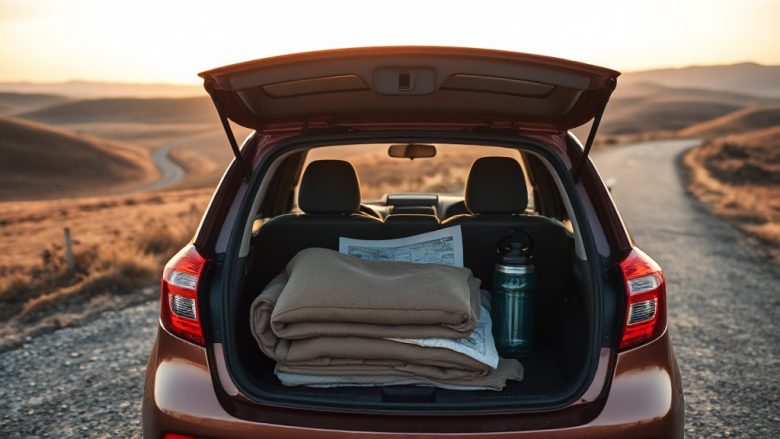
The first decision in any road trip isn’t where to sleep or what to pack. It’s how far you’re willing to drive in a day. Most beginners plan a trip that looks modest on a map and turns out to be brutal behind the wheel, because they’ve never measured a route in hours rather than miles. So before you buy a single gadget, decide what a comfortable day actually looks like for you. This walkthrough covers how to get started with road trips in the order a real trip happens: choose the route, prepare the car, pack the essentials, plan each day, and handle the problems that always show up somewhere. Work through it once and you’ll have a plan you can repeat for years.
Step 1: Choose a Route That Matches Your Comfort Level
Pick a number of driving hours you already know you can handle, then build the trip around it. If you’ve never driven more than two hours at a stretch, a first road trip of three to four hours a day is plenty. That’s roughly 150 to 200 miles on ordinary roads, less if you’re crossing mountains or city traffic. A cautious beginner should aim for a total trip of three or four days, which gives you a real sense of the rhythm without turning the whole thing into a test of endurance.
Route shape matters as much as distance. An out-and-back along one road is the easiest first trip: you learn one corridor, you know where the fuel stops are, and you can turn around early if something goes wrong. A loop is more interesting but demands more planning. A one-way drive with a different return route is the most rewarding and the most demanding, so save it for your second or third trip.
When you’re comparing options, look at the road type, not just the mileage. A hundred miles of motorway is a completely different day from a hundred miles of single-track road with passing places. Check whether your route has long empty stretches without fuel or food, and whether it climbs. Mountain passes add time even when the distance looks short. If a route’s shortest version already feels tight, it’s too ambitious for a first outing.
It also helps to pick a direction with a purpose. A coast, a national park, a friend’s town, a specific viewpoint you’ve wanted to see for years. Destination gives the drive a shape and makes the daily decisions easier. Wandering with no plan sounds romantic and usually ends with a lot of time in car parks arguing about where to eat.
Common mistake: planning the route around the destination and ignoring the driving. The drive is the trip. If the driving isn’t enjoyable, the destination can’t rescue it.
Step 2: Prepare the Car Before You Leave
A road trip doesn’t need a modified vehicle. It needs a car that won’t strand you, and a driver who knows what to check. Do this a week before you leave, not the night before, so there’s time to fix anything you find.
Start with the tyres. Check the pressures when they’re cold, including the spare, and look at the tread depth. A tyre that’s fine for short local trips can be a problem over several hundred miles of hot road. Then check the fluids: engine oil, coolant, brake fluid, and screen wash. Screen wash gets overlooked constantly and you’ll use far more of it on a long drive than you expect, especially in the UK where a dry motorway can still throw up enough spray to blind you.
Test the things you’ll rely on. Wipers, all exterior lights, indicators, horn, and the air conditioning or heater, because you’ll want both at some point. Check the spare wheel and jack are actually in the car and that you know how to use them. If you don’t have a spare, confirm what your repair kit is and where it lives.
If the car is due a service or the MOT is close, bring it forward. Nothing ruins a trip like a warning light appearing 200 miles from home. If you’re not confident checking things yourself, a garage can do a pre-trip inspection for a modest cost and it’s money well spent.
Common mistake: assuming the car is fine because it’s fine around town. Short local trips hide worn tyres, weak batteries and low fluids. Long drives expose all three.
Step 3: Pack the Essentials Without Overpacking
Beginners either pack nothing or pack everything. The right answer is a small, boring kit that covers the realistic problems and nothing more. You don’t need a roof box full of gear for a four-day drive.
Keep a document folder in the glovebox with your licence, insurance details, breakdown cover number, and any paperwork the car needs. Then a basic car kit: a torch, a tyre pressure gauge, jump leads or a jump starter pack, a warning triangle, a high-visibility vest, and a small first aid kit. In the UK, having a hi-vis vest within reach is sensible and often expected, and a warning triangle is worth having even if you never use it.
For the people in the car, the essentials are water, snacks that don’t melt, a phone charger that works from the car, and a paper map or downloaded offline maps. Phone signal disappears in exactly the places you’ll want it. Pack one soft bag per person rather than several small ones, and keep the things you’ll actually want during the day, like water and a jacket, in the cabin rather than the boot.
Clothing is where people overpack. Bring layers, one warm outer layer, and one pair of comfortable shoes you can walk in. If you’re staying somewhere with a washing machine, you can travel with half of what you think you need.
Common mistake: packing for every possible scenario and then digging through a full boot to find the one thing you need. A small kit you understand beats a large kit you don’t.
Step 4: Plan Each Day, Then Let It Bend
A daily plan isn’t a minute-by-minute schedule. It’s three anchor points: where you start, where you stop for the night, and one or two things you actually want to see in between. Everything else is negotiable.
Set a driving limit and stick to it. For most beginners, four hours of actual driving is a full day once you add stops, traffic and the time it takes to find parking. Build in a break every two hours, even if it’s just ten minutes out of the car. Fatigue on long drives creeps up quietly, and the fix is stopping earlier than you feel you need to.
Book accommodation in advance for the first and last nights, and leave the middle flexible if you can. That way you’ve got a guaranteed start and finish but room to stay somewhere longer if you love it. When you book, check parking. A cheap room with no parking can cost more in stress and fees than a slightly pricier one with a space.
Plan fuel around your route, not your mood. Fill up when you’re at half a tank rather than when the light comes on, especially on rural stretches. Note where the long gaps are and treat them as fixed points. The same goes for food: know roughly where you’ll eat lunch, even if it’s just a town you’ll pass through.
Leave slack in every day. The best parts of a road trip are usually unplanned, and you can only enjoy them if the schedule has room for them.
Common mistake: building a plan so tight that one delayed ferry or closed road unravels the whole day. Plan the anchors, not the minutes.
Step 5: Handle Problems Calmly and Know When to Stop
Something will go wrong. A puncture, a closed road, a booked-out town, a warning light. None of these are disasters if you’ve prepared for the possibility. Keep your breakdown cover number where you can find it without unlocking your phone, and know your policy’s limits before you need them.
If a warning light comes on, pull over somewhere safe and check the obvious things: oil, coolant, tyres. If you can’t identify the problem, don’t push on to the next town. Stopping early costs you an hour. Ignoring a problem can cost you an engine.
For route problems, accept diversions as part of the trip. A closed road adds time, not failure. Keep enough fuel and patience in reserve to handle an unexpected detour, and don’t be too proud to turn back if the road ahead looks beyond your comfort level. A road trip you finish safely is a better trip than one you abandon halfway up a mountain pass.
The most important skill is recognising when to stop for the day. If you’re tired, the light is going, or the weather has turned, find somewhere to stay. There’s no prize for finishing the drive you planned. The whole point is to arrive in a state where you can enjoy being there.
Common mistake: treating the plan as a contract. A road trip is a series of decisions, and the good ones are the ones that keep you safe and still having fun.
Frequently Asked Questions
How many hours a day should a beginner drive on a road trip?
Three to four hours of actual driving is a comfortable first-timer’s day. That’s usually enough to cover 150 to 200 miles on ordinary roads, and it leaves time for stops, food and actually seeing something. If you’re new to long drives, start shorter and build up.
Do I need special equipment to start road tripping?
No. A reliable car, a document folder, a basic car kit with a torch and jump leads, water, snacks and a working phone charger will get you through most trips. Add gear only after you’ve found a problem you couldn’t solve without it.
How far in advance should I plan a first road trip?
Two to four weeks is plenty. Use the first week to check the car and choose a route, the second to book the first and last nights, and the rest to sort out packing and daily anchors. Longer trips need more lead time, but a short first trip doesn’t.
What if I get tired in the middle of a long drive?
Stop. Pull into a services or a safe lay-by, get out, walk around, and have water. A twenty-minute break is far cheaper than pushing on. If you’re still tired after stopping, end the day early and find somewhere to stay. No itinerary is worth driving through fatigue.