Grease, Traps and Sewer Lines: A Granja Julieta Restaurant Guide
Closing time in a Granja Julieta kitchen has its own soundtrack: the dishwasher winding down, the last plates stacked, and a floor drain that answers with a slow, wet gurgle. If the fryer oil has just been emptied and the drain is already complaining, the problem is rarely the drain itself. It is the fat, oil and grease that has been cooling and sticking to the inside of the pipe all evening. For restaurant owners and kitchen managers, knowing how that waste behaves — and when to call a desentupidora Granja Julieta — is the difference between a late-night headache and a closed dining room.
This guide is written for food-service operations, not for plumbing engineers. It covers how commercial kitchen waste moves through older pipes, what a grease trap actually catches, and how a simple maintenance schedule keeps sewer lines flowing in a neighborhood where many buildings were never designed for today’s kitchen volumes.
How Grease Behaves in Older Granja Julieta Pipes
Hot oil and greasy wash water leave the sink as a liquid. By the time they travel a few meters through an unheated pipe, they cool, thicken and start to coat the walls. That coating narrows the pipe gradually, so the first sign is usually slow drainage rather than a full blockage. In older buildings, the rough interior of cast iron or aged PVC gives the grease something to grip, and the layer builds faster than most kitchen teams expect.
Once the grease layer is established, it acts like a sponge for everything else that goes down the drain: coffee grounds, eggshell fragments, rice, flour paste and bits of food from the prep sink. The result is a sticky, hardened mass that water can only trickle past. Grease rarely blocks a pipe on its own — it blocks it by trapping solids. That is why a drain that was fine last month can back up suddenly on a busy Friday service.
Why the Problem Shows Up at the Floor Drain First
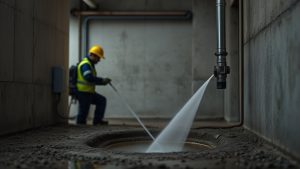
Floor drains sit at the lowest point of the kitchen, so they are usually the first place a partial blockage becomes visible. Water pooling around the drain, a gurgling sound when the dishwasher discharges, or a faint sour smell at the edges of the tile are all early warnings. Ignoring them usually means the next event is a backup at the wrong moment, often during prep for the dinner rush.
In Granja Julieta, many restaurant spaces sit in mixed-use buildings where kitchen drains connect to shared residential stacks. A blockage that starts in one commercial kitchen can therefore affect neighbors above or beside the unit, which turns a private maintenance issue into a building-level problem. That shared risk is one reason commercial kitchens are held to a higher standard of grease management than a home kitchen would be.
What a Grease Trap Catches — and What It Doesn’t
A grease trap or grease interceptor is a settling chamber installed between the kitchen fixtures and the main sewer line. It slows the flow of wastewater so that fats, oils and grease float to the top while solids sink to the bottom. The clearer water in the middle flows out to the sewer. When the trap is working and maintained, it removes a large share of the grease load before it ever reaches the pipe.
The trap does not catch everything. Detergents and hot water can emulsify grease so that it passes through as tiny droplets, and fine food particles can be carried out with the water. A grease trap buys time for the sewer line, but it does not replace pipe maintenance. Kitchens that rely on the trap alone often discover this when the line downstream of the trap starts to smell or drain slowly.
Signs Your Trap Needs Attention
- Standing water or a visible grease cap inside the trap cover.
- Slow drainage at sinks and floor drains even after the trap was recently pumped.
- Persistent odor around the trap lid or in the service corridor.
- Grease visible in the downstream inspection point or manhole.
- Frequent backups that return within weeks of a cleaning.
When these signs appear together, it is worth having the line inspected rather than simply pumping the trap again. A professional team such as a desentupidora Granja Julieta São Paulo SP can assess whether the problem is the trap, the pipe, or both, and recommend the right intervention instead of a temporary fix.
Building a Maintenance Schedule That Fits a Working Kitchen
Most commercial kitchen blockages are predictable. They follow the volume of frying, the size of the trap and the age of the pipe. A maintenance schedule should be built around those three factors rather than a fixed calendar that ignores how the kitchen actually operates. A high-volume fry kitchen may need trap service far more often than a café that grills rather than fries.
Start with daily habits that cost nothing: scrape plates into solid waste before washing, never pour fryer oil down any drain, and use sink strainers that actually fit. Then set a trap-cleaning interval based on the manufacturer’s guidance and the observed grease level, and record each cleaning with the date and the amount removed. Written records turn maintenance from guesswork into a schedule you can defend.
A Practical Schedule for Small Food Businesses
- Daily: scrape, strain and check floor drains for pooling or odor at closing.
- Weekly: inspect the trap surface and remove floating grease if the level is high.
- Monthly: full trap pump-out or cleaning, with a written record.
- Quarterly: professional line inspection, especially in buildings with older pipes.
- Annually: review the whole drainage path, including shared stacks and inspection points.
For kitchens in older Granja Julieta buildings, a quarterly inspection is often the most valuable item on that list. It catches the narrowing grease layer before it becomes a full blockage, and it gives the owner time to plan the work instead of paying for an emergency call during service. When a blockage does happen, a desentupidora em Granja Julieta São Paulo SP can clear the line and advise on the changes that will keep it clear.
A Closing Note for Kitchen Managers
The gurgle at closing time is not a personality quirk of an old building. It is information. Grease is accumulating somewhere in the line, and the floor drain is telling you before the dining room does. Restaurants that treat that sound as a maintenance trigger rather than background noise spend far less on emergency plumbing and lose far fewer service hours.
Keep the trap serviced, keep the records, and keep an eye on the drains that speak up first. A well-run grease management routine protects the sewer line, the neighbors in shared buildings, and the reputation of the kitchen itself. When the line needs professional attention, calling early is always cheaper than calling after the backup.